
Choosing a career
When you leave the Armed Forces, you are not just finding a new job; you are moving into a completely different lifestyle and work environment. Working out how your hard-earned skills fit into the commercial market can feel like a massive hurdle , and it is incredibly common to leave the services with no clear idea of where to start.
Choosing a career that suits your character starts with understanding your personality, values and motivations. Consider how you respond to challenges, the environments where you perform best, and the type of work that gives you satisfaction. By matching your natural strengths and preferences to the right role and workplace culture, you can find a career that offers long-term fulfilment rather than simply a salary. This self-awareness helps ensure a smoother and more successful transition into civilian employment.
While finding your place in the commercial market can be a challenge , veterans possess a profound competitive advantage. Employers actively seek individuals who lead under pressure, thrive in ambiguity, and drive execution. The secret weapon lies in structured self-analysis and the absolute mastery of translation—converting military precision into boardroom language.
1. Inventory & Map Your Transferable Skills
Success begins with honest self-evaluation, digging deep past basic checklists to capture hard achievements and hidden behavioral strengths:
- Hard Skills: Tangible, credential-backed capabilities such as academic degrees, IT/cybersecurity certifications, foreign languages, health and safety standards, and budget or project management training.
- Soft Skills: Personal strengths frequently rated by corporate employers above technical ability—including emotional intelligence, composure under pressure, resourcefulness, adaptive leadership, and complex problem-solving.
- Uncover Hidden Assets: Extract skills from your entire lifestyle, including official postings, major logistics, personal hobbies, military sports, and peer performance appraisals.
- Utilize Resettlement Tools: Leverage professional testing platforms, such as the My World of Work psychometric tool or Career Transition Partnership (CTP) myPlan assessment modules.
2. The Universal Translation Filter
Corporate hiring managers rarely understand military terminology. To resonate, completely strip away jargon and refocus explicitly on your responsibilities, structural scale, and direct commercial equivalents:
Military Terminology |
Civilian Corporate Equivalent |
Mission |
Project, Objective, Corporate Goal |
Subordinate / Squadron / Platoon |
Team Member / Direct Report / Team / Department |
Company / Combat Environment |
Division / High-Pressure, Challenging Environment |
Reconnaissance / Ammunition |
Research & Intelligence Gathering / Supplies & Resources |
Lance Corporal / Corporal / Sergeant |
Assistant Supervisor / Team Leader / Manager |
Warrant Officer / Sergeant Major |
Department Manager / Senior Team Supervisor |
Operations Officer / Major / Brigadier |
Operations Manager / General Manager / Managing Director |
3. Define Personal Priorities & Targets
Avoid the "spray and pray" application trap. Maximize your tactical focus by narrowing your search criteria to a maximum of two to three roles across one or two target sectors:
- Operational Boundaries: Clearly pinpoint target industries, personal geographical boundaries, corporate cultures, and specific minimum salary baseline targets.
- Decompression Reality: Establish a realistic timeline for availability, explicitly deciding if you require time to decompress, upskill, or reconnect with family.
- Target Military-Friendly Sectors: Focus heavily on industries with robust veteran pipelines, including Security (physical, maritime, cyber ops), Construction & Infrastructure (logistics, project management), Technology (software engineering, DevOps, data analytics), and Financial Services.
- Verify Employer Commitments: Target organizations holding Gold Status within the Employer Recognition Scheme (ERS) or those explicitly bound by the Armed Forces Covenant.
4. Build High-Impact Narrative Evidence
Civilian recruiters demand proof through relatable storytelling. Utilize the structured framework: Situation Action Taken Measurable Corporate Result.
- Contextualize Complex Scenarios: If you brokered solutions with local leaders or foreign forces, articulate it clearly: "Successfully negotiated resolutions within an operationally complex, multilingual environment under severe constraints."
- Quantify Scale Clearly: Never leave achievements generalized. Always document exact headcounts managed, asset values supervised, or percentage efficiencies driven.
- Pitch Value Over History: Your civilian CV is a dynamic marketing tool, not a historical service record. Ensure every sentence explicitly proves what you can execute for the hiring organization tomorrow.
5. The Strategic Transition Checklist
- Categorize your top hard and soft credentials, retaining only commercial relevance.
- Filter every line of your CV and interview talking points through the corporate translation key.
- Finalize parameters regarding salary, culture, location, and decompression timing.
- Conduct primary market intelligence using industry insight days, LinkedIn networking, and veteran job fairs.
- Construct a strict target pipeline containing up to 10 verified Forces-friendly employers.
Transforming your military experience into a standout LinkedIn profile
Transitioning from the UK Armed Forces into civilian employment is a massive cultural shift. You are leaving a world where your rank, regiment, and uniform instantly communicate your skills, and stepping into a digital marketplace where recruiters often have zero understanding of military terminology. It can be incredibly frustrating to know you have led teams under extreme pressure, only to struggle to get noticed online.
Let’s be candid: in the civilian job market, your LinkedIn profile is your new uniform. It is often the first impression you make on a hiring manager. If they cannot decipher your military history, they will simply scroll past. The good news is that you already possess the exact leadership, resilience, and problem-solving skills employers are looking for—you just need to translate them into a language they understand.
Here is your tactical guide to building a LinkedIn profile that bridges the gap between the barracks and the boardroom, backed by insights from top UK veteran employment experts.
1. Demilitarise Your Headline and Summary
Your headline is the most visible part of your profile. The biggest mistake service leavers make is keeping military acronyms front and center. Civilians do not know what a SNCO, REME, or an OJAR is.
- Rank to Role: Instead of listing your exact rank or unit as your headline (e.g., "WO2 infantry"), translate it into its civilian equivalent. Use terms like "Senior Operations Manager", "Logistics Specialist", or "Team Leader".
- Write a Civilian-Friendly Summary: Use the "About" section to tell your story in plain English. State who you are, what you excel at, and what you are looking for next.
- Focus on the Future: While you should be immensely proud of your service, focus your summary on how your military background makes you a tangible asset in the corporate world.
Pro Tip: Ask a civilian friend to read your summary. If they have to ask what an acronym or operation means, delete it and simplify the language.
2. Translate Your Experience and Arsenal of Skills
The Forces Employment Charity, which provides lifelong employment support to veterans, emphasises that you are not just listing your postings; you are showcasing transferable skills. Civilian employers highly prize veterans for their agility and problem-solving capabilities.
- Plain English Operations: Instead of saying, "Deployed on Op HERRICK managing a FOB," write, "Managed a remote operational base of 150 personnel in a high-pressure, hostile environment."
- Quantify Your Impact: In the corporate world, numbers matter. Did you manage a £5 million equipment budget? Did you lead a team of 30 personnel under tight deadlines? Put those figures directly into your experience bullet points.
- Highlight the "Soft Skills": Make sure your profile prominently features highly sought-after competencies like cross-functional communication, risk management, and strategic planning.
3. Expand Your Perimeter: Networking
LinkedIn is a networking platform, not just a static CV. The transition process can feel isolating, but there is a massive, supportive veteran community already established online that is ready to help you.
- Connect with Fellow Veterans: Search for veterans who have transitioned into the industries you want to join. A simple connection request saying, "Hi [Name], I am currently transitioning out of the Forces and would love to connect and follow your journey in [Industry]," is highly effective.
- Join Relevant Groups: Search for and join groups related to the Forces Employment Charity, the CTP, and broader UK Armed Forces professional networks.
- Follow Forces-Friendly Employers: Keep an eye on companies that have signed the Armed Forces Covenant and actively recruit veterans, and engage with their content.
4. Constant Vigilance: Keep it Active
A dormant profile will not get you noticed by the algorithm. You need to show up on recruiters' feeds consistently.
- Engage Meaningfully: Like and comment thoughtfully on posts from thought leaders and companies in your target industry.
- Share Your Journey: Do not be afraid to post about your resettlement courses, the civilian qualifications you are earning, or your honest reflections on transitioning. Authenticity plays incredibly well on LinkedIn.
- Turn on "Open to Work": Utilize this feature to quietly signal to recruiters that you are actively seeking civilian opportunities.
Your military career has forged you into a highly capable professional with a distinct advantage. Your only mission now is to communicate it clearly.
Translating your military service into a standout CV
Leaving the UK Armed Forces is a monumental life change. You are stepping out of a highly structured environment where your rank, regiment, and deployments speak for themselves, and into a civilian job market where recruiters often have zero understanding of military life. It can feel incredibly frustrating to know you have led teams under extreme pressure, yet struggle to get past an initial CV screening.
But here is the reality check: civilian hiring managers will not take the time to decode your military jargon. It is entirely up to you to translate your service into a language they understand. The good news? You already possess exactly what they are looking for—you just need to package it correctly.
Here is your tactical guide to writing a CV that bridges the gap between the barracks and the boardroom, backed by insights from top UK veteran employment experts.
1. Demilitarize Your Language
The number one mistake service leavers make is keeping military acronyms in their CV. Civilians do not know what a SNCO, REME, or an OJAR is, and a confused recruiter will simply move on to the next application.
- Rank to Role: Instead of listing your exact rank, translate it into its civilian equivalent.
- Section Commander becomes Team Leader or Supervisor.
- Company Commander / OC becomes Operations Manager or Department Head.
- Quartermaster becomes Logistics / Supply Chain Manager.
- Plain English Operations: Instead of saying, "Deployed on Op HERRICK managing a FOB," say, "Managed a remote operational base of 150 personnel in a high-pressure, hostile environment."
- Ditch the Acronyms: Replace terms like MOD, NCO, and AWOL with universally understood phrases like Government Defence, Mid-level Management, and Unauthorised Absence.
2. Showcase Your Transferable Skills
A major report titled "Veterans Work" (produced by Deloitte, the Forces Employment Charity, and the MoD) highlighted that civilian employers highly prize veterans for their "soft skills." You aren't just a rifleman, a medic, or an engineer; you are a problem-solver.
Make sure your CV prominently features these highly sought-after, transferable skills:
- Leadership and Management: Detail how many people you led, the budgets you managed, and the assets you were responsible for (put a monetary value on equipment where possible).
- Agility and Problem Solving: Highlight instances where you had to adapt to rapidly changing situations with limited resources.
- Communication: Mention your experience giving briefings, writing reports, or liaising with multinational forces or local civilian authorities.
- Resilience and Work Ethic: Employers know veterans can handle stress. Quantify this by mentioning the tight deadlines and high stakes you successfully navigated.
3. Choose the Right CV Structure
The Forces Employment Charity advises that a traditional chronological CV (listing your jobs from newest to oldest) might not always be the best fit for a service leaver, especially if you have spent 20 years in one organisation.
Consider these alternative structures:
- The Skills-Based (Functional) CV: This format puts your skills (e.g., Project Management, Leadership, Technical Maintenance) at the very top, grouping your military achievements under these civilian-friendly headings. Your actual employment history follows briefly at the bottom.
- The Hybrid CV: A combination of the two. Start with a powerful personal profile and a bulleted "Core Competencies" section, followed by a demilitarized chronological work history. This is often the most effective route for service leavers.
4. Tailor the Document to the Mission
Just as you wouldn't use the same tactics for every operation, you shouldn't use the same CV for every job application.
- Read the Job Description: Mirror the language used in the civilian job advert. If they ask for "stakeholder engagement," ensure those exact words appear in your CV where you describe working with allied forces or local leaders.
- Keep it Concise: The CTP strongly recommends keeping your CV to a maximum of two pages. Civilian recruiters spend an average of 6 to 8 seconds glancing at a CV before making a decision.
- Focus on Achievements, Not Just Duties: Don't just list what you were supposed to do; list what you achieved. Use the STAR method (Situation, Task, Action, Result) in your bullet points. Example: "Redesigned the unit's supply chain protocol (Action), reducing equipment delivery times by 20% (Result)."
Further Reading and Lifelines
Do not attempt to do this in a vacuum. Utilize the free resources available to UK service personnel:
- Career Transition Partnership (CTP): Access their CV building tools and one-on-one career consultant advice.
- Forces Employment Charity: Offers lifelong employment support for all veterans, regardless of rank or length of service.
- Barclays AFTER Programme: An excellent corporate initiative that helps veterans transition, offering great examples of how corporate UK views military talent.
Your military career has given you a distinct advantage; your only mission now is to communicate it clearly.
Top Employers
UK’s top Forces friendly employers of service leavers, veterans and their families. All the companies listed achieved gold status with The Employer Recognition Scheme (ERS), which acknowledges businesses that provide exceptional support to the Armed Forces community.
Further Education
Use our searchable database to find publicly funded further education higher education (PF FE/HE) scheme providers for UK Armed Forces service leavers. This vital military resettlement scheme grants eligible service leavers a fully funded first further or higher education qualification, including a diploma, foundation degree, or undergraduate degree.
Service Leavers' Guide
Last checked 28th May 2026
This Armed Forces resettlement guide has been produced from the gov.uk website to provide help and advice on a range of topics as you plan for your transition to civilian life. It aims to give useful information on the sort of help you can get, who can provide it and the action you need to take.


The Future Of Heating Engineers
What does the future of gas look like?
The current state of the heating market is looking very fruitful for engineers. Just as we saw in 1967 when we went from town gas to natural gas from the North Sea, change is coming. When we went to natural gas, the demand for engineers was at a peak. The changeover meant constant work for engineers and made a career in gas very in demand.
With the popularity of the air source heat pump courses Gastec run, you can see a similar trend in engineers becoming multi-skilled as they wait to see what fuel sources will become the new normal. It is common knowledge that heat pumps will never be suitable for every home in the U.K., and reading the popular press, you will see a heavy investment in hydrogen. A gas and hydrogen blend is looking very likely as a stepping stone towards net zero. The future of heating engineers will be a multi-trade discipline with engineers holding qualifications in multiple work areas.
Whatever the fuel source, a level 3 qualification in any of the Gastec ELC-approved courses will be the first step towards a fruitful career in heating engineering.
What is Gastec able to offer my business opportunities?
Here at Gastec, we branch out to multiple sectors of the heating industry, we cover a lot more than just Gas Safe courses. Over the years, we have seen thousands of engineers leave service and gain domestic Gas Safe accreditation. However, the journey only starts here. Branching out your portfolio of qualifications is a surefire way to increase your business opportunities; why not offer heat pump installations to your customers? Or even branch into OFTEC oil accreditation. Whichever route you take with your business, we have three decades of experience to guide you in the right direction.
What Qualifications Will I Get for Using My ELC Funding with Gastec Training?
The Gastec domestic Managed learning programmes contain everything you need to start working in domestic or commercial properties under your own Gas Safe registration or under any company as soon as possible.
In all areas of gas work, a core gas safety assessment must be achieved before an individual appliance assessment can be undertaken. Core gas safety assessments exist for domestic gas, liquid propane gas, commercial gas, commercial catering, commercial laundry, gas emergency service providers, and metering opportunities.
For Example:
Domestic Natural Gas:
You first obtain a core Domestic Gas Safety – CCN1 (compulsory), which now includes CPA1 (combustion performance analysis).
Once the core CCN1 has been completed, the appliance assessment relevant to your work can be achieved.
Think of a core ACS qualification as the hub from which you can branch out your portfolio.
Common appliances to extend your CCN1 from are:
Central Heating Boilers & Water Heaters – CENWAT
Cookers – CKR1
Gas Fires – HTR1
Meters – MET1
All of the above are standard with Gastec’s domestic managed learning programme. Be careful when selecting your provider because if you get stuck with only a CCN1 and CENWAT qualification, you must wait 12 months with Gas Safe registration before adding any appliance. Gastec ensures you leave with qualifications that set you up for instant employment or self-employment. Whichever MLP you decide to take, rest assured that your journey doesn’t stop there; the horizon is endless for business opportunities.
Sitemap
A complete list of all the pages and content on Quest Online.
Quest Online Terms of Service and Privacy Policy
Welcome to our website. If you continue to browse and use this website, you are agreeing to comply with and be bound by the following terms and conditions of use, which together with our privacy policy govern Questonline relationship with you in relation to this website. If you disagree with any part of these terms and conditions, please do not use our website.
The term ‘Questonline’ or ‘us’ or ‘we’ refers to the owner of the website whose registered office is High Hall, Walsham Le Willows, Bury St Edmunds, Suffolk, IP31 3BN. Our company registration number is 3138960. The term ‘you’ refers to the user or viewer of our website.
The use of this website is subject to the following terms of use:
- The content of the pages of this website is for your general information and use only. It is subject to change without notice.
- This website uses cookies to monitor browsing preferences. If you do allow cookies to be used, the following personal information may be stored by us for use by third parties: When using our websites, you can set your browser to refuse all or some browser cookies, or to alert you when websites set or access cookies. If you disable or refuse cookies, please note that some parts of this website may become inaccessible or not function properly. For more information about the cookies we use, please see our cookie policy.
- Neither we nor any third parties provide any warranty or guarantee as to the accuracy, timeliness, performance, completeness or suitability of the information and materials found or offered on this website for any particular purpose. You acknowledge that such information and materials may contain inaccuracies or errors and we expressly exclude liability for any such inaccuracies or errors to the fullest extent permitted by law.
- Your use of any information or materials on this website is entirely at your own risk, for which we shall not be liable. It shall be your own responsibility to ensure that any products, services or information available through this website meet your specific requirements.
- This website contains material which is owned by or licensed to us. This material includes, but is not limited to, the design, layout, look, appearance and graphics. Reproduction is prohibited other than in accordance with the copyright notice, which forms part of these terms and conditions.
- All trademarks reproduced in this website, which are not the property of, or licensed to the operator, are acknowledged on the website.
- Unauthorised use of this website may give rise to a claim for damages and/or be a criminal offence.
- From time to time, this website may also include links to other websites. These links are provided for your convenience to provide further information. They do not signify that we endorse the website(s). We have no responsibility for the content of the linked website(s).
- Your use of this website and any dispute arising out of such use of the website is subject to the laws of England, Northern Ireland, Scotland and Wales.
Privacy Policy
Personal data collected, used, stored and transferred by us may include:
- Identity Data including forenames, last name, maiden name, date of birth, gender, marital status, and username or similar identifier
- Contact Data including home address, email address and telephone numbers
- Transaction Data including payments made for services you have purchased from us
- Technical Data including internet protocol (IP) address, browser type and version, time zone setting and location, browser plug-in types and versions, operating system and platform and other technology on the devices used to access our website(s)
- Profile and Usage Data including orders placed by you, feedback and survey responses, and how you use our website, products and services
- Marketing and Communications Data including your preferences in receiving marketing from us and our business partners and your communication preferences
How do we collect your personal data?
Personal data is collected by us using the following methods:
- Direct interactions with staff in person, by post, phone, email or otherwise.
- Automated technologies or interactions with our website, by using the web enquiry form subscription form.
How do we use your personal data?
| Purpose / Activity | Type(s) of data | Lawful basis for processing |
| Accounts | Identity / Contact / Financial Transactions / Marketing & Comms | Necessary for our legitimate interests ie to recover debts due to us. |
| Initial Contact to discuss your requirements | Identity / Contact | Consent |
| To administer and protect our business and our website (including troubleshooting, data analysis, testing, system maintenance, support, reporting and hosting of data) | Identity / Contact / Technical |
To comply with a legal obligation. Necessary for our legitimate interests (to provide admin and IT services, network security. Fraud prevention) |
| To deliver relevant website content and advertisements to you and measure or understand the effectiveness of the advertising we serve to you. |
|
Necessary for our legitimate interests (to study how readers and advertisers use our publications and how we can improve them) |
To manage our relationship with you which will include:
|
Identity Contact Profile & Usage Transaction Marketing & Comms |
Necessary for our legitimate interests. To review existing relationships and to maintain and improve customer service. |
| To use data analytics to improve our website, publications, marketing, customer relationships and experiences. | Technical Profile & Usage |
Necessary for our legitimate interests (to analyse customer usage, update our website(s), to develop our business and improve our marketing. |
Change of purpose
We will only use your personal data for the purposes stated in the table, unless we reasonably consider that we need to use it for another reason and it is compatible with the original purpose.
If we need to use your personal data for an unrelated purpose, we will notify you and explain the legal basis which allows us to do so. Please note that we may process your personal data without your knowledge or consent, in compliance with the above rules, where this is required or permitted by law.
Changes to our Privacy Notice
We keep our Privacy Notice under regular review and we will place any updates on this web page. This Privacy Notice was last updated on 1stMay 2018.
Marketing Communications
You will also have the choice to opt-in to receiving related marketing information and related products and services.
You can opt-out of receiving these types of communications at any time by contacting us via email or clicking on the relevant link in email communications you receive from us.
However please note that your personal information will not be passed to any third-party organisation for marketing purposes.
Data Security
We have put in place appropriate security measures to prevent your personal data from being accidentally lost, used or accessed in an unauthorised way, altered or disclosed. We also limit access to your personal data to only those Quest staff, appointed representatives, advisers, business partners and suppliers who have a business need to know. They will only process your personal data on our instructions and they are subject to a duty of confidentiality.
We have put in place procedures to deal with any suspected personal data breach and will notify you and any applicable regulator of a breach where we are legally required to do so.
Cookies
When using our websites, you can set your browser to refuse all or some browser cookies, or to alert you when websites set or access cookies. If you disable or refuse cookies, please note that some parts of this website may become inaccessible or not function properly. For more information about the cookies we use, please see our cookie policy.
Website Third-party links
Our website may include links to third-party websites, plug-ins and applications. Clicking on those links or enabling those connections may allow third parties to collect or share data about you. We do not control these third-party websites and are not responsible for their privacy statements. When you leave our website, we encourage you to read the privacy notice of every website you visit.
Sharing of personal data outside of the European Economic Area
Some of our external suppliers are based outside the European Economic Area (EEA) so their processing of your personal data will involve a transfer of data outside the EEA. Where we use providers based in the US, we may transfer data to them if they are part of the Privacy Shield which requires them to provide similar protection to personal data shared between the Europe and the US.
We may also use specific contracts approved by the European Commission that provide the same level of protection for personal data as it has in the EEA.
Who we disclose personal data to
Your personal data may be shared with third parties for the following purposes:
Distribution of our magazines.
These companies are required to ensure appropriate security measures are in place and maintain the confidentiality of your personal data, and to use your personal data only in the course of providing such services and in accordance with Questonlines instructions.
How long is your personal data retained?
We only retain your personal data for as long as necessary. This depends on what the personal data is used for.
Your legal rights regarding your personal data after the retention period; if there is no other on-going relationship your personal data will be securely deleted.
You have the right to:
- Request access to your personal data. This enables you to receive a copy of the personal data we hold about you and to check that we are lawfully processing it.
- Request correction of the personal data. This enables you to have any incomplete or inaccurate data corrected, though we may need to verify the accuracy of the new data you provide to us.
- Request erasure of your personal data. This enables you to ask us to delete personal data where there is no good reason for us continuing to process it. You can also to ask us to delete your personal data where you have successfully objected to the processing (see below), where we may have processed your information unlawfully or where we are required to erase your personal data to comply with local law. Note, however, that we may not always be able to delete the data for specific legal reasons which will be notified to you, if applicable, at the time of your request.
- Object to processing of your personal data where we are relying on a legitimate interest (or those of a third party) and there is something about your particular situation which makes you want to object to processing on this ground as you feel it impacts on your fundamental rights and freedoms. You also have the right to object where we are processing your personal data for direct marketing purposes. In some cases, we may demonstrate that we have compelling legitimate grounds to process your information which override your rights and freedoms.
- Request restriction of processing of your personal data. This enables you to ask us to suspend the processing of your personal data in the following scenarios: (a) if you want us to establish the data's accuracy; (b) where our use of the data is unlawful but you do not want us to erase it; (c) where you need us to hold the data even if we no longer require it as you need it to establish, exercise or defend legal claims; or (d) you have objected to our use of your data but we need to verify whether we have overriding legitimate grounds to use it.
- Request the transfer of your personal data to you or to a third party. We will provide to you, or a third party you have chosen, your personal data in a structured, commonly used, machine-readable format. Note that this right only applies to automated information which you initially provided consent for us to use or where we used the information to perform a contract with you.
- Withdraw consent at any time where we are relying on consent to process your personal data. However, this will not affect the lawfulness of any processing carried out before you withdraw your consent. If you withdraw your consent, we may not be able to provide certain products or services to you. We will advise you if this is the case at the time you withdraw your consent.
Advertising Enquiries
Since 1999, QUEST has been informing its readers of their education and career options, and the steps they need to take to transition smoothly into civilian life. A comprehensive educational, resettlement and recruitment resource, QUEST’s main function is to provide up-to-date information and guidance on the funding available to members of the Armed Forces, either serving, resettling or veterans. The invaluable and sought-after information in its pages has proven to be effective in assisting ELCAS-funded candidates with their course bookings to enhance their career prospects.
Resettlement/Recruitment Advertisement Enquiries:
Email: [email protected]
T. 01359 259444 or 07341 924766
Welcome to the latest Quest Magazine
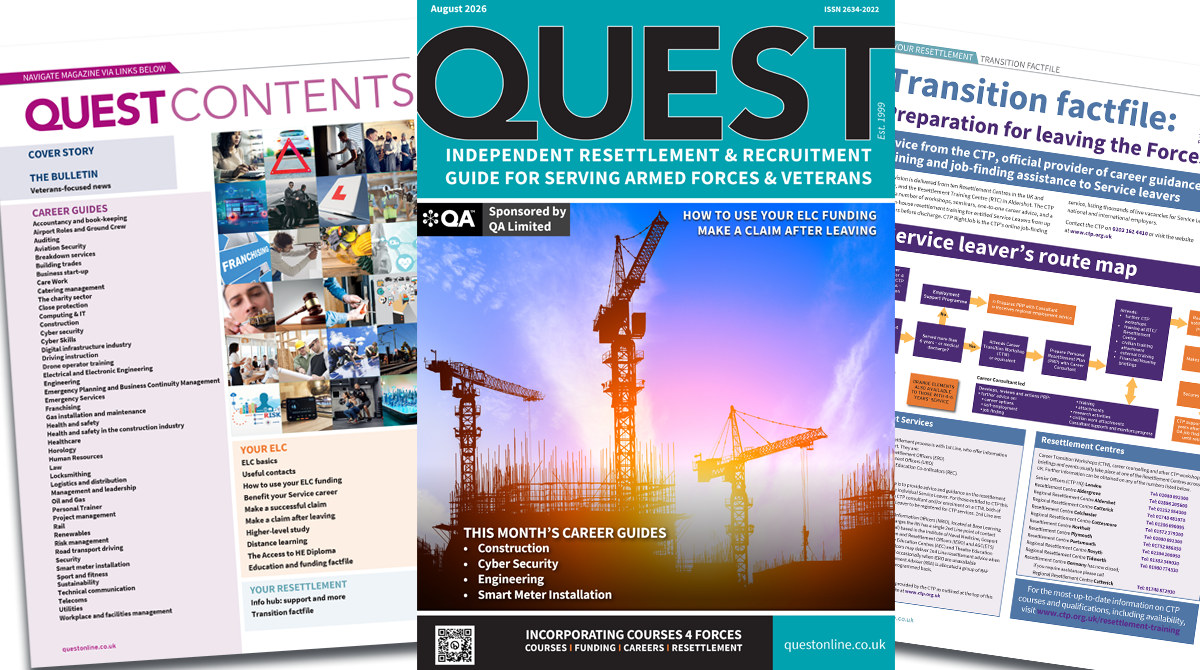
Latest issue....

Subscribe for free....

Catch up on our full Archive....
About Quest
QUEST – Has established itself over 20 years as the go-to resettlement guide to careers and training opportunities for those leaving HM Armed Forces, Veterans and families.
Published monthly, Quest E-magazine brings readers the best of both worlds – so, whether they are still in uniform or have already started preparing for life ‘on the outside’, it’s the only E-magazine providing essential information on funding, courses, training, careers and transition.
It’s essentially a ‘magazine of two halves’: the first part puts at readers’ fingertips everything they need to know about claiming their ELC and how best to use it – whether they are currently serving or have already left but are still eligible to make a claim. As well as all the important ins and outs of the ELC application and claims process, QUEST also highlights how distance learning can help in the quest for qualifications, and homes in on higher-level study options, if that’s where readers are setting their sights. Each issue also spotlights selected career areas that we know from experience are popular choices with both Service leavers and those still serving but already thinking ahead to their transition. Readers can find out about the sort of courses that will help them further their skills in these areas – whether to boost their Service career prospects or to smooth their resettlement with relevant qualifications that will make them more desirable employees on leaving. The section winds up with our one-stop ‘Funding Factfile’, which sums up the financial support available to assist readers’ learning pursuits.
Part two of QUEST presents the usual mix of inspiration and practical guidance on resettlement issues that our readers have come to expect. From how-to guides to buying your own house to putting your pension plans in order, from reader success stories to civvy-savvy advice from those who have already negotiated the route through resettlement. Backing all this up are full Career Transition Partnership course and events listings and our own ‘Transition Factfile’ – readers’ one-stop shop for useful info from a range of sources. Holding all this together is ‘The Hub’ – home to pivotal information on course and training options, transition news and reader reports.
By gathering together under one roof, in a handy monthly guide, the essential course and career information our readers need, QUEST aims to support the UK’s Service personnel throughout their military careers and beyond.
Charity News
Charities dedicated to the Armed Forces are created with the specific purpose of assisting both former and current members of the Armed Forces, along with their families.
In the UK, the sector comprises a wide variety of such charities, with an estimated 500 organisations focused on providing welfare support to a community of roughly 6.5 million people. Directory of supporting charities
Charity Directory
The Armed Forces Charity Directory is a guide of Armed Forces Charities, with the aim of highlighting the great work they do in supporting the Armed Forces community.
Events Diary
Schools
Schools appearing on Questonline present an incredible double benefit by granting bursaries for the children of military personnel and providing job possibilities to those transitioning out of the military service. These educational institutions acknowledge the remarkable contributions made by military families and servicemen and women, and are dedicated to assisting them during their shift. By offering bursaries, they secure quality education access for service members' children, cultivating a supportive atmosphere that appreciates their distinctive situations. At the same time, these schools are eager to employ skilled and disciplined veterans and military personnel, recognising the invaluable competencies they introduce to the civilian work environment. This collaboration with Questonline enables schools to demonstrate their commitment to uplifting military families and professionals, and it cultivates enduring connections that are mutually beneficial for the individuals and the institutions alike. Why advertise your school with us?
Sign up for Quest
Apprenticeships
When leaving Service you may wish to change trades or career completely or you may have left after a shorter Service and wish to learn a trade and gain qualifications so in either situation an Apprenticeship may be something to consider. Apprenticeships allow you to combine work and study by mixing on-the-job training with classroom learning. You'll be employed to do a real job while studying for a formal qualification, usually for one day a week either at a college or a training centre. By the end of your apprenticeship, you'll hopefully have gained the skills and knowledge needed to either succeed in your chosen career or progress onto the next apprenticeship level. Click here to see apprenticeships feature.
Franchises
Self-starter? If you’re thinking of going it alone and running your own business or taking on a franchise, there’s lots of advice to be had on topics from start-up funding to filling in tax returns. Want to find out more? Read our franchise article here
Enquiry Form
If you have any questions, comments or would like to know more about Quest, please complete the form below or email us at [email protected].
Career Guides
Already know what kind of career you’d like to move in to? Or maybe you’re still looking for information that’ll help you make up your mind? Whatever stage you’re at, the QUEST Careers Hub provides in-depth insight on a wide range of industry sectors. To find out more, click on your area of interest below or use the search facility.
Jobs
With almost two decades of working with Service leavers to help them prepare for the next part of their working life, in the civilian workplace, QUEST is well placed to help you make your next career move. Check out our jobs listings below to find your next perfect placement …
Training Courses
Our searchable database helps UK Armed Forces personnel and Service leavers find ELCAS approved training courses for their military resettlement and career transition. Use your Enhanced Learning Credits (ELC) towards a nationally recognised qualification and plan your successful civilian future.
If you are looking for higher education click here.
- Featured Advertisers -